Salt Water Applications
General Information
Salt Water is perhaps the worst environment one can have for Dry
Hydrant installations. While it is difficult these concerns can
be overcome with good planning. Some of the problems encountered
are:
- Barnacles forming on the strainer preventing full flow.
- Corrosion of materials.
- Ultraviolet Rays of the Sun.
- Constant Wave Action and/or Boats.
- Silt and/or suspended debris.
Below we will address how to mitigate each of these issues. You
will note some of these have several solutions. You will need to
evaluate each one to decide which solution best fits your situation.
1. Barnacles
A. Paint
Anti-fowling Marine paint often works very well. Especially in
brackish water. As added insurance you may wish to attach the strainer
using threaded adapters, which can be screwed on and off for cleaning.
The strainer can then be removed, as needed, cleaned repainted and
replaced with minimal effort. To save dive time it may be useful
to have a spare strainer already made up and painted. The spare
can then just be swapped out with the one being removed. (Use 1
male and 1 female PVC Couplings for attachment. These are available
in 6" and 8" sizes.) Anti-fowling Marine Paint can usually
be obtained at most large marina's or boat repair locations.
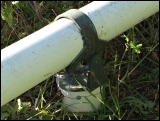
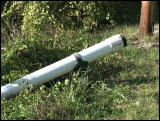
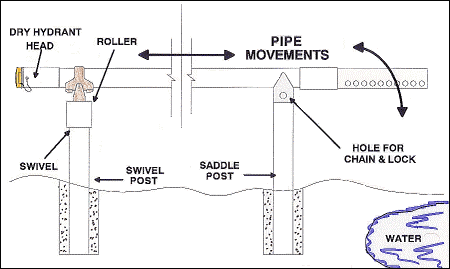
B. Fistular Dry Hydrant Installation - "Patented" -
The Swivel Kit is designed for special applications where the strainer
is not desired to be in the water all of the time. Obvious if the
strainer is not in the water barnacles will not grow on it. It works
like a giant suction straw. It rests in place until needed. To use,
you simply pivot the strainer end up, rotate it around and slide
it gently into the water. The device uses a 180 Deg Dry Hydrant
Head but can use a variety of strainers. The picture below shows
a 6" Horizontal Strainer.
The kit includes the Swivel and Pivot Device along with two Cradles.
Cradles are used to support the pipe and strainer in both the "at
rest" and "in use" positions. System as shown uses
one 20 ft section of 6" Schedule 40 PVC Pipe. Great for salt
water applications.
| Part
No. |
Size |
Description |
| 9182-000 |
6" |
Swivel Kit – Fistular
Dry Hydrant |
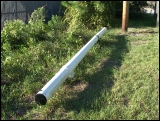
Typical installation noted below:
(click on image for larger view)
Diagram of Swivel Kit:

C. PVC/Flex Joint - Dry Hydrant Installation
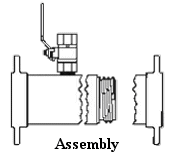
Use of a flexible suction hose provides another solution in keeping
the strainer out of the water. The one shown here is designed to
glue into a 6" or larger PVC pipe. The 3 ft. section comes
complete with 6" PVC Straight Pipe Connections on each end.
The collars are the same as used on the suction hoses and can be
changed in the field if needed. The black helical hose is translucent
and water can be seen as drafting proceeds.
| Part
No. |
Size |
Description |
| 9681-000 |
6" |
PVC/Flex Joint Assembly |
(click on image for larger view)

Installation in normal "up" position. Dry Hydrant in foreground.
|

Horizontal view of installation.
Pulley allows strainer to be lowered.
|

Basket Strainer on end.
|

Strainer lowered into the water ready for use.
|
3 ft. PVC/Flex Joint as purchased.
(click on image for larger view)

Flex Assembly with PVC Ends.
|

End view with collar.
|
Diagram of Flex Hose & Strainer mounted under pier

2. Corrosion of Materials
Salt Water is very corrosive to most materials. Non Ferrous materials
such as PVC, Plastics and Fiberglass hold up pretty well. For submerged
water applications metals which work well are Bronze and 316 SST.
Anodized Aluminum works ok out of the water when used in applications
such as a Dry Hydrant Head.
PVC and Plastics are subject to UV Rays and will require painting
or coating with a heavy paint to prevent the material from becoming
brittle.
Recommended strainers for salt-water applications are made of PVC.
Dry Hydrant Head assemblies can be Bronze are Anodized Aluminum
as they are not submerged in the water all of the time.
3. Ultraviolet Rays of the Sun
As noted above the UV Rays of the sun can cause materials such
as PVC, Plastic and Fiberglass to become brittle or chalky. The
first signs of material degradation will be a white chalky appearance
on the surface of the material. A heavy paint will greatly prolong
the life of these materials. Use Acrylic, Epoxy, or Outdoor Latex
Paints. Apply a generous coat. Annual inspection is needed and additional
paint may be needed at this time. If flex hose is used it should
be inspected annually also for deterioration.
4. Constant Wave Action and/or Boats
Water can be relentless and the constant pounding of the surf can
take its toll on the strongest of materials. If it is an installation
in an area where waves or boat wakes are common, it is best to pick
a design where the strainer and pipe is out of the water, or is
permanently installed below the bottom of the ocean. Strainers installed
on the bottom are also subject to suspended debris as noted below.
If Dry Hydrants are installed near a pier or marina it is best
to install them underneath a pier. This provides support, partial
protection from the sun and protection from boats.
5. Suspended Debris
Suspended debris such as sand and seaweed are commonplace in some
locations. Usually the heavier materials are found near the floor
of the ocean while the lighter material may actually float on or
near the surface. For this type of installation it is best to pull
your water supply from approximately 2 feet below the surface or
3 feet above the floor.
For permanently installed strainers on the bottom this debris can
be overcome by elevating the intakes above the floor of the ocean.
One design that works well is to install a “Tee” at
the end of the buried pipe. Extend each side with pipe to form the
horizontal support. At each end glue a 90-degree elbow and point
it toward the surface of the ocean. These extensions should be high
enough to clear the debris field (2-3 feet). At the end of each
arm you can now install strainers. Barrel type strainers work well
in this application. (A Diagram of this type of installation can
be found under the design called Silt or Mud – Look under
Dry Hydrant Designs)
For suspended debris on or near the surface in may be necessary
to add some type of flotation device to suspend the intake approximately
2 ft. below the waters surface. A round boat buoy works well. (See
also Floating Intake Design – Look under Dry Hydrant Designs)
|