
Above Ground Installation
Checklist and Instructions for Horizontal Strainers
Water Source
Determine the depth of water at piping entry location. In ponds, use low water level if known to ensure operation during droughts.
A minimum of two feet of water over pipe is necessary to avoid cavitation.
Feet or Lift
Lift in excess of 15 feet needs to be avoided, a maximum of 10 feet for other than Class "A" pumps. The lift is the vertical distance from the water's surface to the hydrant outlet.
Accessibility
Hydrants should be located with the following considerations:
- All weather access.
- Sustained maximum grade of 8 percent.
- Road width minimum of 12 feet.
- Proper drainage of site.
- Proper measures to control erosion.
Coordination
Permission of land owner is needed if site is on private property. Local fire department needs to be notified, and should also be discussed with home owner insurance carrier.
We feel the length of pipe should be held to around 40 feet maximum if at all possible. While the horizontal pipe should always be below water, that may not always be the case as the pipe should have a gradual slope toward the pond. During Drought conditions, long pipe lengths could lead to primer pump burnout.
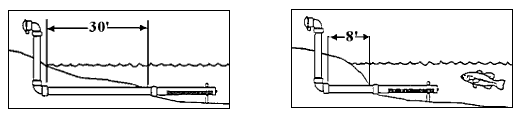
- Hydrants will need to be installed in deep water rather than in the shallow end. This is necessary due to the reach of a backhoe. On a shallow slope, the reach would exceed the 10 - foot to 12 - foot capability of most equipment.
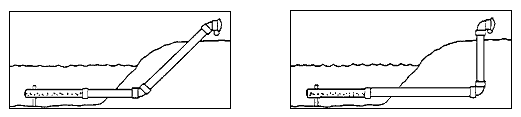
Both a 45-degree or 90-degree configuration can be used to install the dry hydrant. One may be a better choice than the other depending upon terrain at the site location.
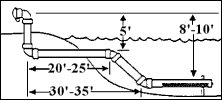
On short pipe installations of approximately 30 feet, we found a slight variation could be done to significantly add to the draw-down depth during drought conditions.
Of course this could only be done in deep ponds, but the total pipe installation for priming would still remain within reason (40 feet maximum including 10 feet of priming suction hose).
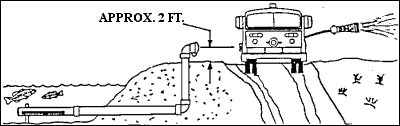
Height of the dry hydrant above the ground should be approximately 2 feet or lower than the intake of the responding fire truck.
Installing Your Dry Hydrant
- Make sure to use 6-inch, Schedule-40 PVC pipe and fittings. Avoid allowing direct sunlight to come in contact with PVC for extended periods of time prior to installation. An epoxy paint can be applied to that portion extending above ground to aid in preventing ultraviolet degradation.
- A backhoe should be used to excavate a 3-foot deep trench below the water surface.
- Once a trench has been dug, connect all PVC pipe, fittings, and strainer together using a Tetrahydrofurance (THF) primer, and between an 800-1000 centipose viscosity cement. Never use all-purpose cements to join PVC pipe and fittings.
- Once all components are properly affixed and allowed to dry, the entire structure should be lowered into the water in one piece.
- Back-fill the trench beginning at the dry hydrant head and proceed toward the water's edge.
- Cut the vertical section of PVC pipe extending above ground leaving approximately two feet of pipe. Deburr the pipe using knife or file and cement dry hydrant head into place.
- Insert 1-inch pipe through submerged PVC strainer and clamp into place.